

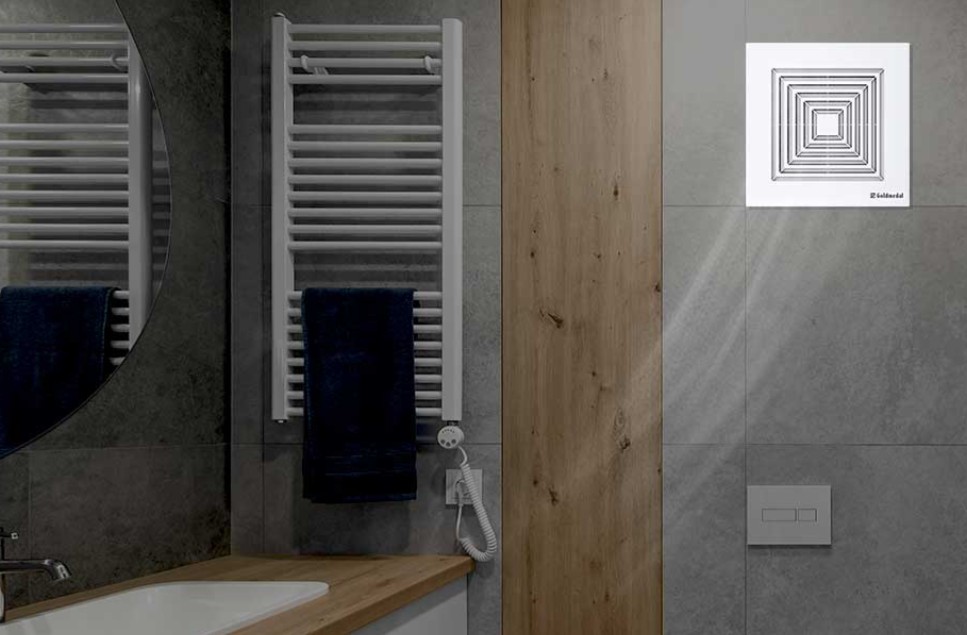
Ever notice how the mirror just won’t clear? You’ve towelled off, brushed your teeth, walked out, and twenty minutes on it’s still a grey smear. There’s that smell too. Damp. A little sour. And up near the ceiling, in the corner, a patch of black that wasn’t there last July.
That’s not the monsoon’s fault. Not really. It’s the fan.
We tend to treat exhaust fans for bathroom ventilation the way we treat the geyser switch. Install it, forget it, assume it’s fine. Most of the year it is. Then June rolls in off the Arabian Sea, the air turns to soup, and that little fan is suddenly out of its depth.
The monsoon changes the maths
Here’s what people miss. Dry-season air has room to soak up the steam from your shower. Monsoon air doesn’t.
By July, relative humidity across a lot of Indian cities sits north of 80 percent, and if you’re anywhere near the coast it can cling to the mid-90s for a week straight. Your bathroom starts every shower already half-drowned. The steam has nowhere to go.
So the fan works harder for less. Water vapour that used to just vanish now beads on the tiles, pools in the grout, seeps quietly into the plaster behind your paint. You won’t catch it happening. You’ll find the evidence later, in a warped door, a bubbling wall, a towel rail gone spotty with rust.
That slow, invisible waterlogging is why exhaust fans for bathroom use get quietly overwhelmed every single monsoon.
How to tell yours has quit on you
You don’t need a meter. Underpowered exhaust fans for bathroom spaces announce themselves, you just have to know the tells:
- A mirror that stays fogged more than ten minutes after you’re done
- Black speckling along grout, ceiling edges, or the silicone round the sink
- That cupboard-y damp smell that survives even a proper clean
- Paint lifting or blistering up high, where the moist air collects
And the one anyone can do tonight. Switch the fan on, tear off a square of tissue, hold it flat to the grille. A working exhaust fan should pin that tissue in place by suction alone. Let go and it stays put. If it flutters down the second your fingers leave, your fan’s moving air in name only.
Old motors are usually the culprit. The shaded-pole type most of us grew up with loses puff year on year, guzzling the same current while shifting less and less.
The number that actually matters
Sizing a fan isn’t a vibe. It’s arithmetic, and getting it wrong is exactly why so many bathrooms stay clammy no matter how long the thing runs.
The metric to know is air changes per hour, ACH for short. It’s how many times the fan can swap out the room’s entire lungful of air in sixty minutes. Bathrooms are greedy here, because they make their moisture in sudden bursts. Ventilation folks generally say aim for six to eight changes an hour, and if you’re up against a coastal monsoon, plant yourself firmly at eight.
| Bathroom size | Air delivery you want | Fan size to look at |
| Small, up to 40 sq ft | 3 to 4 CMM | 150 mm |
| Medium, 40 to 70 sq ft | 5 to 7 CMM | 200 mm |
| Large, over 70 sq ft | 8 CMM plus | 250 mm or ducted |
What you actually get from upgrading
Bigger isn’t the whole story. The better question is how much air per watt, and how quietly.
That’s where BLDC motors earn their keep. Brushless direct current, if we’re spelling it out. They pull a steadier, stronger draught while sipping a fraction of the power an old induction motor drinks, and across a monsoon where the fan’s on for hours a day, that gap shows up on your bill. The near-silence is just a bonus you’ll thank yourself for at 6am.
When you’re comparing exhaust fans for bathroom duty, ignore the price sticker for a minute and check three things: the CMM rating, the motor type, and whether the size honestly fits your room. A fan sized a touch generous clears the damp fast, you flip it off, done. Cheaper over a season than an underpowered one droning all afternoon.
And it pays you back in what stops going wrong. No repainting. No re-grouting. No prising off a swollen skirting board. No scrubbing mould you’d frankly rather not be breathing in.
Conclusion
Water damage is sneaky like that. By the time you can see the mould, it’s been busy behind the paint for a fortnight.
If your bathroom’s ticking these boxes, don’t file it under next-year jobs. Match the fan to the room, pick a motor that won’t quit halfway through the season, and let the air actually move. The best exhaust fans for bathroom humidity were never the loudest in the shop. They’re the ones matched properly to the space they’re asked to keep dry.